Liquor, Gaming and Cannabis Authority of Manitoba

The Canadian gambling regulation market is a unique ecosystem where provincial and state authorities play a key role. In Manitoba, the Liquor, Gaming and Cannabis Authority of Manitoba is the primary supervisory institution. As an expert in international gambling law and compliance, I closely follow the evolution of Canadian regulatory bodies. The LGCA's activities demonstrate one of the most balanced approaches to overseeing the entertainment industry, placing public interest, social responsibility, and citizen safety at the forefront.
The historic consolidation of regulatory functions in 2014, when the Manitoba Gaming Control Commission and the regulatory services division of the Manitoba Liquor Control Commission merged to form the LGA structure, was a crucial step toward creating a single-window control system. Subsequently, the agency expanded its authority by adding oversight of non-medical cannabis in 2018 and horse racing regulation in 2022, demonstrating its flexibility. The proclamation of the Horse Racing Modernization Act permanently consolidated all key sectors under LGCA management.
For operators and market participants, the LGCA acts as a strict yet predictable arbiter. The regulator has built a transparent control system covering large commercial casinos and equipment suppliers, as well as charitable lotteries and small establishments with VLT terminals. A key feature of Canadian provincial jurisdictions is the division of functions: while the state corporation Manitoba Liquor & Lotteries manages commercial operations and owns infrastructure, the LGCA provides independent oversight, licensing, and process integrity verification.
The regulator earns special respect by integrating social responsibility standards, respect for First Nations rights, and scientific research into its daily operations. Staff training programs, continuous market monitoring, and comprehensive background checks on applicants make Manitoba a safe environment for users. In today's world, where the security of financial transactions is paramount, processing payments through verified services such as Interac has become standard practice for licensed establishments.
Recommended Casinos Liquor, Gaming and Cannabis Authority of Manitoba
Canadian players value the reliability and deposit protection provided by Manitoba's state standards. When choosing a place to gamble, users should look for an official permit from the local regulator. The province's land-based and official digital gambling establishments offer strong security, transparent payout rules, and qualified customer support.
Every recommended gambling establishment undergoes multi-level checks by state controllers. Inspections cover not only the operating company's financial stability, but also the technical compliance of every slot machine, roulette wheel, or gaming terminal. Interacting with verified establishments ensures users play on certified equipment and that modern encryption protocols protect their personal data.
The recommended services category includes establishments that provide the following level of service
- full compliance with the laws of the province of Manitoba and active licensing documentation,
- integration of certified software from leading global providers and regular random number generator audits,
- fast withdrawal of funds using the popular Neteller payment system,
- access to responsible gambling programs and the ability to set personal limits on deposits and sessions,
- professional customer support operating around the clock in multiple languages.
By choosing a recommended gambling site, gaming enthusiasts can be confident their rights will be respected. In such establishments, result tampering is strictly impossible, and any disputes are handled in full compliance with the regulator's established framework.
Regulator licensed casinos
Gambling establishments licensed by the Liquor, Gaming and Cannabis Authority of Manitoba set the benchmark for integrity and legal transparency. Obtaining LGCA licensee status is extremely difficult: applicants undergo thorough background investigations covering financial history, beneficial owners, and key personnel. This creates an environment where rogue operators cannot exist.
Licensing covers both large land-based complexes and online channels functioning within the provincial model. Every gambling site permitted by the LGCA must strictly follow customer identification procedures, prevent underage access, and actively combat money laundering.
Casinos licensed by this regulator are distinguished by the following characteristics
- strict player identity verification procedures prior to processing the first payout,
- mandatory quality certificates for all presented slot machines and payout tables,
- support for convenient and secure deposit options, including the trusted Skrill system,
- regular financial reporting and activity audits by state inspectors,
- integration into a unified responsible gambling database to prevent problem gambling development.
Players who choose an online casino licensed by the LGCA can be confident their funds are protected under Manitoba's legal framework. Violations of license conditions can lead to severe fines or revocation, so operators protect their reputation and maintain high service standards.
Liquor, Gaming and Cannabis Authority of Manitoba review
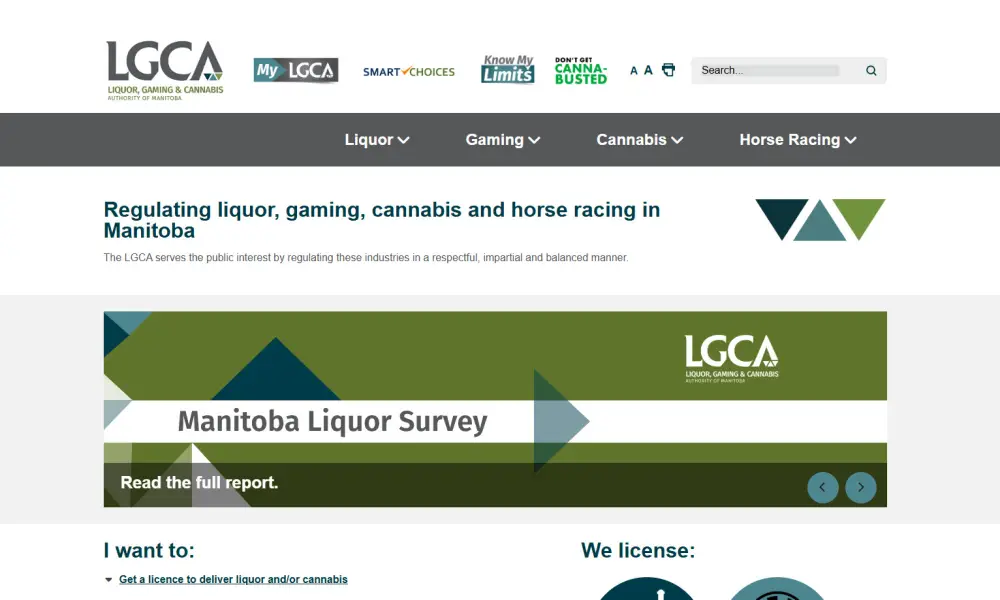
The Liquor, Gaming and Cannabis Authority of Manitoba (LGCA) is a single provincial body authorized to regulate liquor, gambling, retail cannabis, and horse racing in Manitoba. The regulator's activities aim to protect the public interest by creating a safe, fair, and transparent environment for businesses and consumers.
The organization's history reflects the gradual integration of related regulated industries into a single effective mechanism. In 2014, the merger of the Manitoba Gaming Control Commission and the regulatory division of the Manitoba Liquor Control Commission formed the Liquor and Gaming Authority of Manitoba (LGA). In October 2018, with the legalization of non-medical cannabis at the federal level in Canada, the Liquor, Gaming and Cannabis Control Act came into force, giving the agency its modern name — LGCA. Later, on April 1, 2022, the Horse Racing Modernization Act took effect, repealing the Horse Racing Commission Act and transferring horse racing oversight to the LGCA.
The legal framework rests on a comprehensive set of legislative acts. The foundational document is the Liquor, Gaming and Cannabis Control Act. Under its umbrella, several specialized regulations operate
- Gaming Regulation 62/2014, establishing rules for conducting gambling activities,
- General Regulation 117/2023, governing general management and compliance matters,
- Licensing and Appeals Regulation 63/2014, defining licensing procedures and appeal processes,
- Horse Racing Regulation 40/2022 and Pari-Mutuel Levy Regulation 22/2022, regulating horse racing and betting,
- Cannabis Regulation 120/2018 alongside various liquor control regulations.
A Board appointed by the Lieutenant-Governor-in-Council leads the regulator. The Board sets strategic direction, advises the Minister on policy, and hears appeals of decisions made by the Executive Director. The Board Chair (Pat Britton), Vice-Chair (Stéphane D. Dorge), and Executive Director/CEO (Kristianne Dechant) provide leadership.
The operational structure of the LGCA is divided into two core departments
- Commercial Services Department, responsible for licensing commercial enterprises, including casinos, gaming suppliers, cannabis retail stores, hospitality venues, and liquor manufacturers,
- Gaming Services Department, handling permits for charitable and community events, sports drafts, bingo, and licensing horse racing participants.
A key part of LGCA's work is social responsibility and scientific research. The organization funds research projects, awards academic scholarships, runs public campaigns such as Know My Gambling Limits and Not all raffles are legal, and manages the mandatory Smart Choices staff certification program. The regulator actively advances accessibility standards under its Accessibility Plan 2025-2027 and acknowledges Indigenous treaty rights on traditional lands. For commercial licensing transactions, the regulator accepts fees only in CAD, while operators often use Visa for convenient settlement with suppliers.
Gallery
License types of Liquor, Gaming and Cannabis Authority of Manitoba
The LGCA regulatory framework provides a comprehensive classification of licenses and permits covering all levels of the gambling industry and related fields. Each license category features specific applicant requirements, documentation packages, and oversight protocols.
The primary license and permit types within the LGCA jurisdiction include the following areas
- commercial licenses for casino operators and gambling establishments,
- licenses for Video Lottery Terminal siteholders (VLT Siteholders),
- permits for lottery ticket retailers (Lottery Ticket Retailers),
- licenses for equipment suppliers and service providers (Suppliers and Service Providers),
- personal licenses for gaming industry employees (Gaming Employees),
- permits for charitable and social occasion gambling (Charitable Gaming / Social Occasion Raffles),
- licenses for horse racing participants, tracks, and betting theatres (Horse Racing Participants & Track Operators).
Licensing for commercial casinos and VLT siteholders occurs in close coordination with the state-owned Manitoba Liquor & Lotteries. Venues seeking VLT terminals must hold an age-restricted liquor service license. The state owns the terminals, while the LGCA issues siteholder licenses free of charge after background checks. A similar approach applies to lottery ticket retailers: Manitoba Liquor & Lotteries grants commercial location approval, after which the LGCA audits the applicant and issues the license fee-free.
Equipment and service providers (Suppliers and Service Providers) must be licensed prior to conducting business in Manitoba. This category includes manufacturers of slot machines, chips, cards, security systems, marketing agencies, and ticket processors. Applicants complete extensive disclosure forms, including the Multi-Jurisdictional Personal History Disclosure. Annual fee amounts depend on the provided goods or services and must be paid strictly in Canadian dollars. Suppliers are required to file an Annual Update report and promptly disclose any litigation or shareholder changes.
Gaming employee licensing (Gaming Employees) is mandatory for all personnel working in the province's gambling industry. Individuals cannot apply directly; an application is initiated only after receiving a job offer from an approved employer (Manitoba Liquor & Lotteries, Aseneskak Casino, Sand Hills Casino, or South Beach Casino). Background investigations take 3 to 5 business days. Employees must notify the LGCA of any personal detail changes, bankruptcies, or employer disciplinary actions.
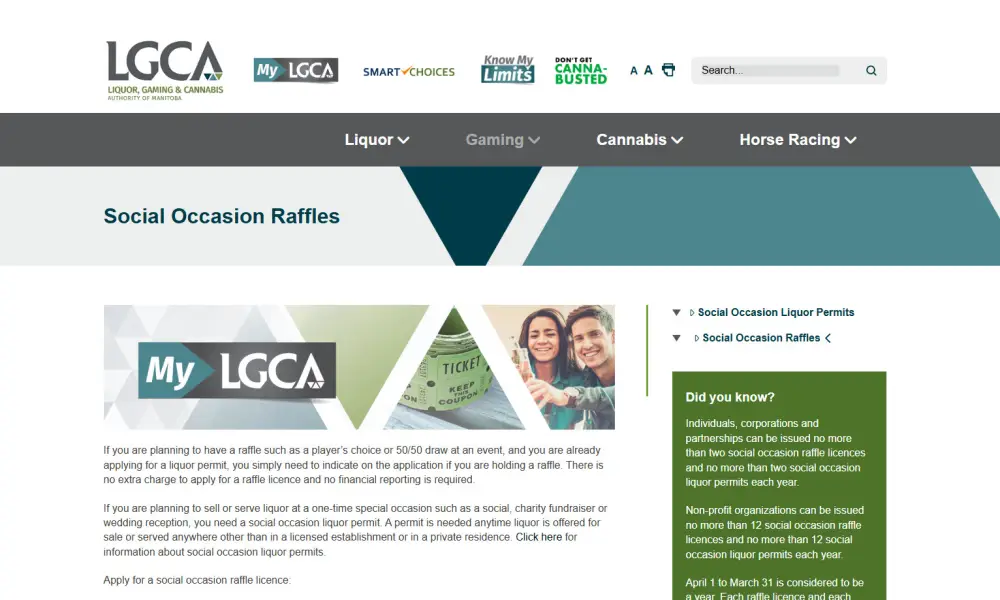
Charitable and religious organizations may apply for special licenses for raffles, bingo, Texas Hold'em poker tournaments, sports drafts, and Monte Carlo events. Raised funds must go to social, educational, or athletic causes. For one-time celebration events (weddings, socials), the LGCA issues simplified Social Occasion Raffle permits without extra fees, provided the event takes place in a public place of amusement. In horse racing, the LGCA licenses jockeys, trainers, horse owners, racetracks, and betting theatres. To facilitate international settlements, equipment vendors frequently utilize the Mastercard payment system.
Dispute resolution
Consumer protection and ensuring process integrity are central priorities for the LGCA. Manitoba's jurisdiction provides a structured, clear system for resolving disputes between players, venue visitors, and licensed operators.
The dispute and complaint review procedure involves the following required steps
- submitting an initial inquiry or complaint directly to the management of the gambling establishment or online casino,
- conducting an internal investigation by the operator with a written response provided to the complainant within set timelines,
- escalating the dispute to the LGCA complaint division if the player disagrees with the operator's decision,
- performing an independent review by regulator inspectors, including audits of technical logs, financial records, and video footage,
- issuing an official determination or order by the LGCA Executive Director,
- filing an appeal against the Executive Director's decision to the LGCA Board.
Any player may file a complaint against a licensed establishment through the regulator's official website or by telephone. LGCA inspectors are granted broad authority to conduct unannounced inspections, audit software, and analyze financial transactions. If an investigation reveals that a dispute stems from payout delays or technical glitches, the regulator thoroughly inspects the entire transaction chain, including payment details processed via the Paysafecard system.
When an operator breaches license terms or fair play standards, the LGCA enforces administrative measures. The body can issue warnings, impose monetary penalties, suspend licenses, or revoke authorizations completely. The Board publishes appeal decisions openly on the regulator's portal, ensuring maximum transparency in Manitoba's enforcement practices.
Conclusion
The Liquor, Gaming and Cannabis Authority of Manitoba (LGCA) is an example of a highly efficient, modern state regulator. Unifying the oversight of liquor, gambling, cannabis, and horse racing under one roof enabled Manitoba to establish consistent standards across all industry sectors. This framework reduces administrative burdens for businesses while improving public safety.
For users, an LGCA license serves as an unconditional guarantee of integrity, reliability, and financial safety. Uncompromising personnel screening, strict equipment supplier oversight, and mandatory Smart Choices staff training cultivate a civilized environment where gambling remains purely a form of entertainment.
The regulator continues to enhance its services, adapting legislation to evolving technological trends and modern demands. Ongoing investments in scientific research, active public engagement, and commitment to accessibility standards make the LGCA a recognized leader in North American gambling oversight. Trusted payment methods like PayPal, paired with rigorous provincial supervision, ensure a comfortable and secure experience for every player.
Frequently asked questions
The Liquor, Gaming and Cannabis Authority of Manitoba is Manitoba's official provincial regulatory body, responsible for licensing and oversight of liquor distribution, gambling operations, retail cannabis sales, and horse racing. The authority's primary goal is to protect the public interest, ensure public safety, and maintain business integrity.
The Liquor, Gaming and Cannabis Authority of Manitoba conducts thorough background checks on license applicants, licenses all gaming venue employees, certifies gaming equipment, oversees suppliers, and conducts scheduled and unannounced inspections of operators. The regulator also monitors compliance with responsible gambling rules and handles consumer complaints.
A Board of Directors, appointed by the Lieutenant Governor in Council, leads the Liquor, Gaming and Cannabis Authority of Manitoba. Pat Britton chairs the Board, Stéphane D. Dorge serves as Vice-Chair, and Kristianne Dechant is Executive Director and CEO.
The Liquor, Gaming and Cannabis Authority of Manitoba oversees the mandatory Smart Choices certification program required for all hospitality and cannabis retail employees. This course teaches safety regulations, ID verification procedures, preventing service to intoxicated patrons, and identifying signs of problem gambling.
The Liquor, Gaming and Cannabis Authority of Manitoba accepts and investigates user complaints against licensed operators if the dispute cannot be resolved directly with the venue. The authority's inspectors review technical data and documentation, after which the regulator issues a decision binding on the operator.
The Liquor, Gaming and Cannabis Authority of Manitoba issues licenses to lottery ticket retailers and VLT siteholders at no cost. However, before applying, applicants must obtain commercial approval from the state corporation Manitoba Liquor & Lotteries.
The Liquor, Gaming and Cannabis Authority of Manitoba funds and conducts independent research projects by providing academic scholarships and grants. It uses the findings to refine legislation, develop social programs, and improve the effectiveness of measures to combat gambling addiction.

To leave a comment, you must log in:


| Main info | |
| Name | Liquor, Gaming and Cannabis Authority of Manitoba |
| Site languages | English, Français |
| Website | https://lgcamb.ca/ |
| 🗓️ Foundation date | 2014 |
| Contacts | |
| Feedback form | Yes |
| 🏠 Post address | 1055 Milt Stegall Drive, Winnipeg, Manitoba, R3G 0Z6, Canada |
-
6.6
-
6.6
-
6.6
-
4
-
5.5
-
6
-
6.3
-
6.6
-
6.3
-
5.3